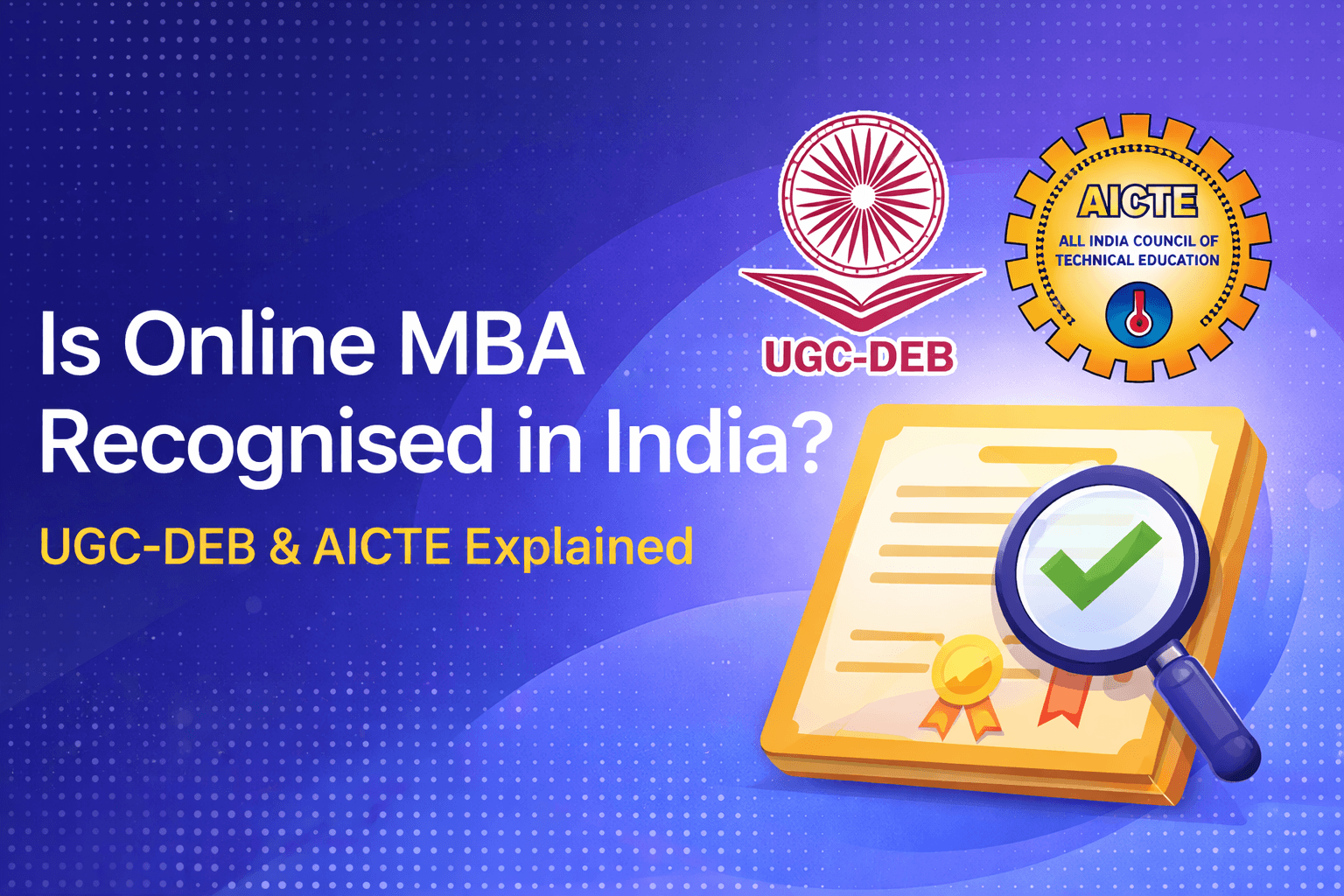
You can get a valid online MBA in India, but recognition depends on the institution and programme status. UGC’s Distance Education Board (DEB) sets rules for online and ODL programmes and grants recognition when a university meets its standards, so check for UGC-DEB approval to confirm legitimacy. AICTE oversees technical and professional approvals and may apply to certain management programmes; its approval matters when the programme falls under its scope.
You should verify recognition yourself before enrolling. Check the institution’s listing on the UGC-DEB portal, confirm programme approval documents, look for AICTE approval if relevant, and review published programme regulations and eligibility criteria. Recognition depends on current approvals and can change, so always confirm the latest status.
Verification checklist recap:
- Confirm UGC-DEB listing for the university and programme
- Request official approval letters or links from the institution
- Check AICTE applicability and approval if applicable
- Verify programme mode (online/ODL) matches DEB rules
- Cross-check dates and validity of approvals
Understanding UGC-DEB and Online MBA Regulations
UGC-DEB sets rules for distance and online programs, and AICTE policies can affect certain professional courses. You need to check whether the program and the university appear on official lists and follow the correct approval route.
UGC and DEB Mandates for Online MBA
UGC is the statutory body that recognizes universities in India. DEB (Distance Education Bureau) is the UGC body that oversees distance and online learning standards. For an online MBA to be UGC-recognised, the offering university must have DEB approval or be authorised under UGC’s online regulations.
DEB evaluates course design, faculty, learning resources, assessment, and student support. It issues guidelines on allowed disciplines and minimum quality standards. If a university offers an online MBA without DEB clearance or outside the permitted disciplines, that programme may not carry UGC recognition.
You should verify DEB approval specifically for the online MBA programme, not just general university recognition. Look for official entries in UGC/DEB lists or the university’s published DEB approval document.
Online and ODL Recognition Requirements
Online and Open and Distance Learning (ODL) programmes must follow the UGC (Open and Distance Learning Programmes and Online Programmes) Regulations, 2020 and later updates. These rules define eligibility for universities, programme structure, contact hours, assessment norms, and use of technology platforms.
Key points to check: the programme is included in the university’s approved list, the mode (fully online vs blended) matches the approval, and the curriculum meets DEB/UGC criteria. DEB may restrict certain professional or technical disciplines from being offered fully online; those require special clearance or face different rules.
Proof of recognition can include a formal DEB approval letter, an entry in the UGC/DEB approved programmes list, or a clear policy statement on the university’s official site that cites DEB authorization for that specific online MBA.
Disclaimer on Recognition Status
Recognition depends on the university and the specific programme, not the degree type alone. You must confirm the exact programme code and approval dates because approvals can change over time.
Do not assume recognition from a university’s general UGC listing. A university may be UGC-recognised for on-campus degrees but not for every online or ODL programme it offers. If you find conflicting information, rely on official UGC/DEB notices or direct confirmation from the regulatory body.
AICTE Approval and Applicability
AICTE sets technical and professional education norms and may apply to management programs in certain cases. Read the points below to know when AICTE rules matter and when they usually do not.
AICTE’s Role in Management Education
AICTE (All India Council for Technical Education) issues norms for technical and professional programs. It oversees infrastructure, faculty standards, and program delivery where its law applies. AICTE often covers programs offered by institutions that fall under its statutory remit or where state rules require its clearance.
If your program is classed as a technical or professional course by state authorities, AICTE standards can affect recognition and quality checks. AICTE does not issue blanket approvals for every management program; its involvement depends on the institution’s legal status and the specific program design.
When AICTE Approval Is Required for Online MBA
AICTE approval becomes relevant if the offering institution is under AICTE’s jurisdiction or if state regulation specifically demands AICTE clearance for that program delivery mode. For example, private institutes set up as technical colleges or campuses governed by AICTE norms may need approval for management courses.
If the online MBA is delivered by a university regulated by UGC/DEB, AICTE approval normally is not required. Check the institution’s statutory category (university, deemed, or affiliated college) and any state notifications. If you see AICTE approval listed, confirm it on the AICTE public portal to ensure it covers the online MBA program specifically.
How to Check Online MBA Recognition Status
You can verify recognition by checking official regulator lists, the university’s registration, and the specific programme approval. Use step-by-step checks, trusted websites, and key documents to confirm if an online MBA is valid for your goals.
Step-by-Step Verification Checklist
- Find the exact university name and programme title as listed on the institute’s official site. Write down the programme code or admission notification if available.
- Check UGC-DEB approval: search the UGC or DEB approved programme list for the university and the specific online MBA programme. Look for the programme year and any notes on restrictions.
- Check AICTE only if the programme or campus claims technical or professional approval. Search AICTE approval lists for the institute or programme name.
- Confirm the university’s legal status (central, state, private, or deemed) on the regulator’s university list. This matters for which regulator’s rules apply.
- Look for programme start date, curriculum outline, and mode (fully online or hybrid). Note any statements about equivalence with on-campus degrees.
- Cross-check degree recognition in employment or professional bodies if you need specific job eligibility.
- Save screenshots or PDFs of regulator pages and the programme page. Record the date you checked each source.
Key Websites for Verification
- UGC (University Grants Commission) site: search the list of recognised universities and any UGC-DEB notices.
- DEB (Distance Education Bureau) pages: look for lists of approved online/ODL programmes and circulars on permitted courses.
- AICTE (All India Council for Technical Education): check the approval portal if the programme claims AICTE oversight.
- State higher education council or official government university list for state-specific recognition details.
- University’s official website: programme page, accreditation section, and statutory documents.
When you search, use exact programme names and note publication dates. Prefer regulator PDFs or official lists over third-party pages.
Documents to Cross-Check
- UGC-DEB/DEB approval letter or listing that mentions the specific online MBA programme. Verify the approval number and date.
- AICTE approval letter or listing if applicable. Confirm the validity period and scope.
- University recognition certificate or gazette notification showing the institution’s legal status. Match the university name and campus address.
- Programme syllabus, scheme of examination, and award rules to confirm degree type (MBA, PG Diploma, etc.).
- Offer letter or admission letter that quotes the programme name exactly as in regulator lists.
Keep copies of these documents and note the URL and date for each online source.
Common Verification Challenges
Regulator lists may use slightly different names for the same university or programme. Small name differences can hide a valid approval.
Some approvals cover the institution but not all programmes. An approved university does not automatically mean every online MBA it offers is recognised.
Third-party education sites may be outdated. Regulators update lists; check timestamps and prefer official PDFs or portal pages.
Hybrid programmes sometimes cause confusion about mode of delivery and eligibility for certain jobs. Read the approval note for delivery mode and any prohibitions.
If regulators show conflicting information, contact the regulator’s helpdesk and the university’s registrar for official clarification, and save all correspondence.
Verification Checklist Recap
Use the official regulator lists first. Check the UGC-DEB list for approved online/ODL programmes and the AICTE list if AICTE approval might apply to the specific MBA format. This gives the primary proof of recognition.
Confirm the university’s legal status. Look for central or state university recognition on government sites. If the university is not listed there, the programme may not be valid.
Match programme mode and approval. Verify that the MBA is explicitly listed as an online or ODL programme in the UGC-DEB records. Approval must mention the mode (online) and the specific programme name.
Check the programme notification or approval order. Download the UGC-DEB approval letter or public notification. Note the approval date, scope, and any conditions stated.
Verify course details and delivery claims. Ensure the curriculum, assessment methods, and contact hours match UGC-DEB requirements. Confirm if any on-campus components are required and whether they were approved.
Look for third-party confirmations. Cross-check employer guidance, professional bodies, or government job notifications when you need the degree for specific roles. These sources help clarify acceptability in practice.
Keep records of all checks. Save screenshots, PDFs of approval notices, and web links with dates. These documents help you prove recognition later if needed.
Frequently Asked Questions
This FAQ answers who regulates online and ODL MBAs, when AICTE matters, how to verify recognition, and where to find official records. Read each answer to check a program’s legal status and what documents to request from an institution.
What is the role of UGC-DEB in regulating Online and ODL programs in India?
UGC-DEB authorises universities to offer online and ODL (open and distance learning) programs. If a university’s online MBA is listed by UGC-DEB, it means the programme meets UGC-DEB rules for delivery and assessment.
UGC-DEB also issues guidelines on curriculum, contact hours, student support, and online exam standards. You should look for the programme’s inclusion on the UGC-DEB approved programme list.
How does AICTE approval impact the validity of an online MBA program in India?
AICTE regulates technical and professional education for certain types of institutions and programmes. If AICTE has specific rules for an online management programme, its approval adds regulatory backing, but AICTE approval is not a universal requirement for all online MBAs.
Check whether AICTE or UGC-DEB is the relevant regulator for that university’s mode of delivery. If AICTE approval is claimed, verify it on AICTE’s official portal.
What steps should I follow to verify the recognition of an online MBA program?
Ask the institution for the programme’s official approval letter or notification.
Cross-check the programme name on the UGC-DEB approved programme list.
Check the university’s recognition status on the UGC or state higher-education regulator site.
Search the AICTE portal if the institution or programme claims AICTE approval.
Confirm that the programme mode (online/ODL) matches the regulator’s approval.
Request the syllabus, evaluation method, and certificate sample to confirm compliance with norms.
Keep copies of all documents and record dates of web pages or PDFs you use for verification.
Can an online MBA be valid in India if it's not recognized by UGC-DEB?
In most cases, an online MBA not recognised by UGC-DEB will raise doubts about its legal standing for employment or higher studies. Some exceptions exist if another statutory regulator (like AICTE) has valid approval for that specific mode and programme.
Do not assume validity; always verify the exact programme approval and the regulator cited.
What should one look for in an institution's status to ensure its online MBA program is recognised?
Look for a clear statement that the university is recognised by UGC or the state higher-education authority. Confirm the programme appears on the UGC-DEB approved programmes list for online/ODL delivery.
Also check whether the university is authorised to offer postgraduate degrees and whether the programme has specific approval or notification from the relevant regulator.
Where can I find official information on the recognition of online education programs?
Use the UGC-DEB approved programme list on the UGC-DEB website for online and ODL programmes. Visit the UGC main website to confirm university recognition.
Check the AICTE portal for any claimed AICTE approvals. Keep official pages or PDFs as proof of verification.